


> Home > What to visit > Palaces and Monuments

Asilo Infantile Buonconvento
PALACES AND MONUMENTS
PHONE NUMBERS AND TIMES
Asilo Infantile
via Dante Alighieri Buonconvento (Siena)
Business card (vCard)
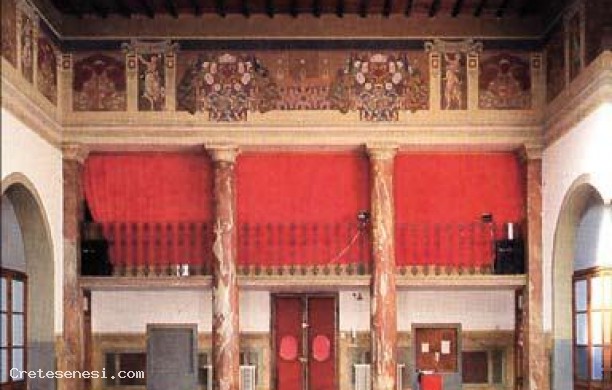
History of the structure: The idea of founding a nursery school in Buonconvento matured after the election as Montepulciano’ s bishop of Monsignor Giuseppe Battignani, already local parson, who, becoming promoter of the initiative, on the 19th January 1899, convoked the Town Hall, a meeting of the most wealthy exponents of the town-community. The nursery school would have been situated in the rooms of an ancient building, inside the historic centre which belonged to the bishop himself, who would have donated it for the occasion; it would have been financed with the offers of the inhabitants and use as staff some nuns of the Congregation of “ Poors’ sisters”. To examine the problem of the seat, after some years used to find the necessary funds through different initiatives, among which a lot of charity bazaars, on the 21st May 1903, it was constituted a Commission made up of local technicians, to which belonged also the sienese architect Bettino Marchetti, who, already on the 12th December 1901,had freely drawn up two draft programmes. On the 22nd January 1905 the Commission, considering not suitable the rooms offered by the bishop, expressed itself for the building from the beginning of a structure which “ met all the hygienic and didactic needs”, assigning its planning to the architect Marchetti. In the meantime they had arrived, at the organizing committee, the agreements of the Commune, the Mutual Benefit Society of workers and women, the Co-operative of Consumption and all the others village-associations and finally, with Royal Decree of the 1st April 1906, the Association became a non-profit agency. The new Marchetti’s project was approved by the board of directors on the 11th November of the same year by the Engineers’ Office and by the Ministry of Public Education in 1907.Going back to the regulations of the Law of the 25th November 1900, the building was on two floors out of land, dimensioned for 120 children with 2 of 60 seats each, a refectory and a central reception-room, and it foresaw possible enlargements in case of a maximum attendance of 180 children. The nursery school, which was foreseen on a land of about 1500 square metres, 540 of which for the structure and 960 for the outdoor gym, would have demanded a starting cost of £ 31279, partly covered by the government aid of£ 10000, obtained thanks to interventions of the deputies, the lawyer Arturo Pilacci and the Count Giovacchino Bastagi. The structure would have been created in brickwork (stones and bricks), with iron beams and vaults as floors, ceilings and roofs in fir wood and floors in cement-tiles in two colours. Mouldings and cornices in brick would have decorated the main front. The necessary land for the building, situated outside the historic centre along the Roman Provincial Road, was offered by the couple Lattanzio and Settimia Marri Mignanelli and accepted by the board of directors on the 11th March 1908; the deed of gift was drawn up “ Terzo Grossi” on the 11th June 1908. The building works, after two private sellings by auction-competitions left desert, they were undertaken on contract, with the deliberation of the board of directors of the 12th October 1908, to the firm “ Martino Fineschi” of Siena, for a net amount of £32443 and a maximum period for the finishing of the work of two years. Once the works were consigned on the 22nd November 1908, the laying of the foundation stone took place on the 6th December of the same year and it was celebrated with a banquet, offered by the Working Society and officiated also by the interventions of the bishop Battignani and the deputy Pilacci. The works, which would have used the building-materials (sand, stones and bricks) which had been given by the local owners (actually made only in part) ,were interrupted by the earthquake of the 25th August 1909, when the walls were already 2 metres high. After the event, Marchetti proposed, on the 5th September 1909, some structural changes, like the realization of the external walls completely in full bricks. In November 1910, the building was covered; in the following January the designer proposed other not foreseen works, which were approved by the board of directors with the only exception of the heating system; in May 1911 we decided to decorate the central room assigning the execution of the frescos to the painter Primo Lavagnini, who finished them in December 1911, with a pay of £485. The wainscot and the columns were painted by Guglielmo Valentini from Siena and paid £270. The external railings, partly coming from a recovery of the contractor firm, was completed by Pasquale Franci from Siena, the waterworks was made by the firm “Martino Bratto” from Siena, the cast-iron balustrades were provided by the firm “ Raffaello Cortigiani” always from Siena, while Francesco Furi, from Buonconvento, made the woodworks. Al the works were finished on the 19th October 1911 with a total amount of £43000. The architect Marchetti ‘s fee, which was estimated in £1500, amounted to £3808 but, owing to the scarce economic resources of the non-profit Agency, ha has never been completely paid. Always because of the difficulties of finding the necessary funds for the furnishing and the staff’s pays, as well as for the political divergences about the management (if it had to be laic or religious)the nursery school was inaugurated only on the 13th June 1915, taking effect the following day with 52 children and only one teacher. Thanks to the government’s aids, the nursery school worked until 1921, but already on the 13th July of the following year, owing to a drastic decrease of the attendances, it was closed and all the staff was dismissed. On the 26th November 1923 it was opened again and assigned to the “Sisters of Nostra Signora del Carmelo”, who will manage it until 1972, when the economic situation of the non-profit Agency became untenable, it was ceded to the Commune, which opened here three sections of nursery school. The building became a property of the Municipal Government on the 9th March 1983, with the extinction of the foundation non- profit Agency. Description of the structure: the building’s value, to organize in the modest architectural panorama of liberty influence which is present in the Sienese province and to link to the recent rediscovery of the architectural production of the beginning of the century in the different local realities, has been recognised thanks to the attention and the study of Letizia Franchina and the Monuments and Fine Arts Service of Siena and Grosseto, which has also organized an exhibition. The building rises just outside the most ancient centre of the village, along “Dante Alighieri” street, which runs in parallel with the Via Cassia, southwards, the surrounding building is made up mainly by residential quarters, mostly small houses and villas alternate by small gardens. Completely created in decorative brickwork, the structure rises in the middle of a not wide allotment, planted with garden, separated from the road by a wrought –iron railings. The front: the main front, of the XIX century, is on two floors out of land, and forms a more advanced central part, framed by two thick pilaster strips and scanned by three arches on the ground floor, with two lateral wings, opened by only one arched-window in the middle. The rhythm of the openings repeats in the same way on the first floor, underlined by a denticulated string course- frame which is proposed again, more full- bodied and jutting, as a cornice of superior coping. The expert building structure around the openings, which are backwards respect to the wall and at the same level of the arches’ springer, where develops a continuous horizontal cornice, creates a sense of movement which partly makes up for the perfectly symmetric and monumental statement of the prospect. These component elements cannot be found in the lateral fronts and in the back, where the brick-surface is continuous and uniform, scanned by the arched windows. The inside: On the inside, after a small atrium, preceded by a short external flight of steps, the structure develops around the wide central room, which is more than 7 metres high and characterized by the presence of a gallery on the entrance- wall, framed by two pilasters and held up by two Tuscan columns, painted in false marble. On the opposite wall, three big openings in axis with front’s arches, communicate with the garden and, together with the three superior rectangular windows, they add light to the already luminous room provided with a wide elevated skylight in the middle of communicating doors with the classrooms, which have a wooden ceiling and original floor in octagonal cement-paving tiles of a bright red. In the main room the floor is richer because of the perimetric chequered fascia in red and white paving tiles. To the simplicity of the distributive articulation and the old-fashioned formal episode of the gallery opposes the vivid pictorial decoration in Art Nouveau style, which is a work of the sienese painter Primo Lavagnini, which runs with a large fascia along the highest part of the walls and which constitutes in conclusion the only significant characteristic of the structure: to the patterns of interlaced peacocks and roses, painted in bright colours on a ochre ground, alternate different puttos, which hold some cards with mural mottos addressed both to the children and the educators( “Be good”, “Be happy”, “Love your parents”, “Love your homeland, love God”, “Educate means love” and so on...), chosen by the bishop Battignani from a rich selection, taken among the others , from Platone, Leibniz and Cicerone. You can find more traditional decorative patterns on the short sides of the skylight’s room, where stands out the coat of arms of the village of Buonconvento, with the lion rampant inside a green wreath on a red ground, enriched with fluttering violet ribbons. The socle is decorated with false marble-images, signed by Guglielmo Valentini, concluded by a thin red and gold lines-strip. The ground floor of the building, conceived and still used as a nursery school, has had very few changes, linked most of all to the necessity of modernization of the equipments and the hygienic services; the first floor of the building, on the lateral front, made up of 4 rooms and reachable by means of a travertine stairs with two flights, situated on the right of the entrance room, it is used today only in part as a dancing room.
STAY NEARBY
GHIBELLINO
BUONCONVENTO
The Hotel “ Ghibellino” put at Yours’ disposal a really modern meeting-r...PERCENNA
BUONCONVENTO
...LA RIPOLINA
BUONCONVENTO
The farmhouse “La Ripolina” is only 3 km from Buonconvento and, because of its...DINING & ENTERTAINMENT NEARBY
BAR MODERNO - Casa del Popolo
BUONCONVENTO
Dal 1949 punto di riferimento della comunità buonconventina!!! Sede di partiti po...Ristorante I Poggioli
BUONCONVENTO
...Ristorante Roma
BUONCONVENTO
...