LANGUAGES:  Website in English  Sito in Italiano

Nuvolari3000.com

/ Home / Comune di Rapolano Terme / Castles /


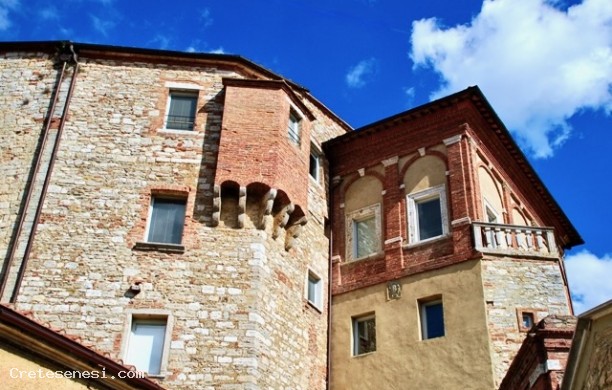
View on mapPalazzo Imperiale ed Antica Grancia di Serre di Rapolano
La facciata interna alle mura

Along with the Port of San Lorenzo stands a large building rather asymmetric, before being transformed into a fortified granary at the Santa Maria della Scala di Siena, was the imperial palace. It was built in several times at the Barbarossa, whose descents in Italy felt the need to strengthen the castles that has always belonged to the empire.

The oldest part of which the palace is made up of a large tower and an extension lowest resting on the wall castellano. A few years later were added to the main building two towers which extend beyond the city walls. The building, which also outside the boundary wall with its towers appeared a strong tool of war, inside, which was opened on the road, constituted a public forum and hosted the curia imperali judges of the presidium and soldiers mercenaries mostly Germans.

The building belonged to the right and, after 1234, Cacciaconti. The latter had the pleasure but not the property, at least in theory remained to. After the departure of Cacciaconti, the palace was assigned the Hospital (based dall'estimo of 1318).

The Hospital of Santa Maria della Scala, so called because Siena stood in front of the steps of the cathedral, was a real economic potentato who maintained thanks to charity donations and private property, intending that, in so doing, seek a place in paradise: the donation was indeed made pro remedio animae. The staff consisted of ordinary monks and nuns, and the marriage was permitted only if it was done before the family was otherwise imposed celibacy. At the time of entry had unconditionally donate all their goods, if they had, in their own person, in exchange for food, clothes and lodging. Friars, nuns and oblates (those that, while donating goods to scales, it reserved the usufruct or pattuivano which would have been serviced and maintained throughout life) lived at the hospital or on farms where they were sent . The rector, who was always a figure of respect, would donate all its assets Scala.

The first case and the first to land seats Serre or in his court were donated to the Hospital of La Scala on 1270 1297 as a result of a huge donation Bernardino D'Alamanno Piccolomini, possessions increased up to give them the consistency of a genuine grangia, ie a fortified place where they gathered products of the farm that the Hospital of Siena possessed.

D'Bernardino Alamanno was a speculatore and usuraio of Siena, to a certain point, he decided to use a large part of its huge gains when buying farm, and the choice fell on the castle of Serre and its fertile court. At any given moment of his life he decided to become Oblate the hospital, that is to donate all the holy Maria della Scala.

At the beginning of the fifteenth century to keep Serraia had been seriously damaged by the Sienese during military operations against rebel Ugo de'Rossi; as a result of this destruction of the government granted to Siena Hospital of Santa Maria della Scala to build a new formwork, not wishing that the castle of Serre remained without a valid fortress. The hospital was authorized to join the palace with the keep of Poggio, to construct a building larger than the old one and suitable to contain large amounts of wheat.

Next to the south facade of the building, where today is the entrance to the museum, is the great gate surmounted by a high wall, fitted with bertesca for throwing boiling oil on any assedianti. The port, built in the days of Paolo di rector Paul Serfucci (1404-1410) was decorated in 1629, when the rector of Philip Tondi, a refined by the newsstand very elegant contours, where today there is a window but originally there was a high with the image of the Madonna. Under the newsstand is cited this inscription:

(LA)
"Ut olei mustique cellae to praedeces
Sor (ibus const) ructae
Magis dies in to egenorum
Auxilium repleantur
Undique urbem versus plus quam ccc just staria
Triad to quinquennia usque in hunc mdcxvii
Vitibus ulmis et oleis culta (IT)
"Because of the cells and must
Built by predecessors
Is increasingly filled
To aid the poor
From all over to the city, more than three hundred of land staia
Three quinquenni were cultivated with vines, elm, and olives
This years until 1617 "


Inside, in front of the door, you open the courtyard which gave access to the granciere, stables, with a desk and some local production and conservation. At the end of the courtyard now stands a wall that leaves only see the traces of a porch with brick arches. A side of the porch was created a small chapel dedicated to Saint Mary Magdalene: it traces remained in a cellar preservative traces of frescoes from different eras (from the fourteenth to nineteenth century). During the rector of Philip Tondi (1519-1527) was built staircase that sustains a side porch two brick arches, where there is a simple port Renaissance style that gave access to the rector of the tower site in the median . Unfortunately, the roof of the lodge blocks in two ancient Romanesque windows that go back to the construction of the building and that today are visible only looking at the building in mid-covered walkway connecting the first to the second courtyard. The rector of this action are remembered by an epigraph placed above the porch walled background, next to the coat of arms at the Scala and Tondi same.

Through the covered walkway you come to a second courtyard at the center with a well with real travertine half of 1700. On the right base of the big tower of the Poggio which we could access through a walk supported by arches resting on three shelves aggettanti one over the other. Traces of this ancient walk you can still see in the loggia d 'access to the shed fieni. At the tower attaches to the wall L rising from the first courtyard. Un'epigrafe recalls the construction company:

A. Domains: MCCCCVII
At the time of venerabi
On: huomo: mis.pav
Him: paulo: retore:
Dil spidale: s: maria. "


In 1555, one of the last episodes of the war of Siena, the Count of Santa Fiora did break down the boundary wall and the Torre del Poggio, which remained standing only basis. The rector Claudio Saracini decided in 1575 to support on the basis of a new tower construction rational use of the farm. On the ground floor was built a big tinaio, with input from the courtyard at the bottom of the covered walkway on the first floor the large barn, the last of the large hut or hay shed the same time un'ascenderia was built to allow carriage of grain to plan for the new barn. Its spiral path is still readable outside and visible within the building.

In 1790 the entire farm was sold buildings and was divided between different owners. During the nineteenth and twentieth century, the building served as a new masters tinaio cellar, barn, warehouse but was partially divided into many small apartments and rented to the poor. Recently much of the complex is now owned by the municipality that has to restoration and that has made in its towers Museum Grangia. Inside the environment is the most impressive exhibition of Rector: it had to receive an initial accommodation in the sixteenth century, as a beam dated 1531, and a further modernization in 1629 when, under the rectorship of Agostino Chigi, there was placed the monumental baroque fireplace forms. On the walls decorated with large portals stone frames with the emblem of the Hospital of Siena. The hall is enriched by a newspaper stone containing traces of a fourteenth century fresco and a incavata niche in the wall with full frame carved stone. The upper floors elegant rooms with frescoes nineteenth; the premises more low for a mill olives which ran until the seventies of the twentieth century.

  Add to favorite places

PHOTOGALLERY

Il palazzo a Porta San Lorenzo

PROPONI CORREZIONI E/O INTEGRAZIONI SULL'ARGOMENTO

Nome e Cognome *
E-mail *
Grazie per la preziosa collaborazione